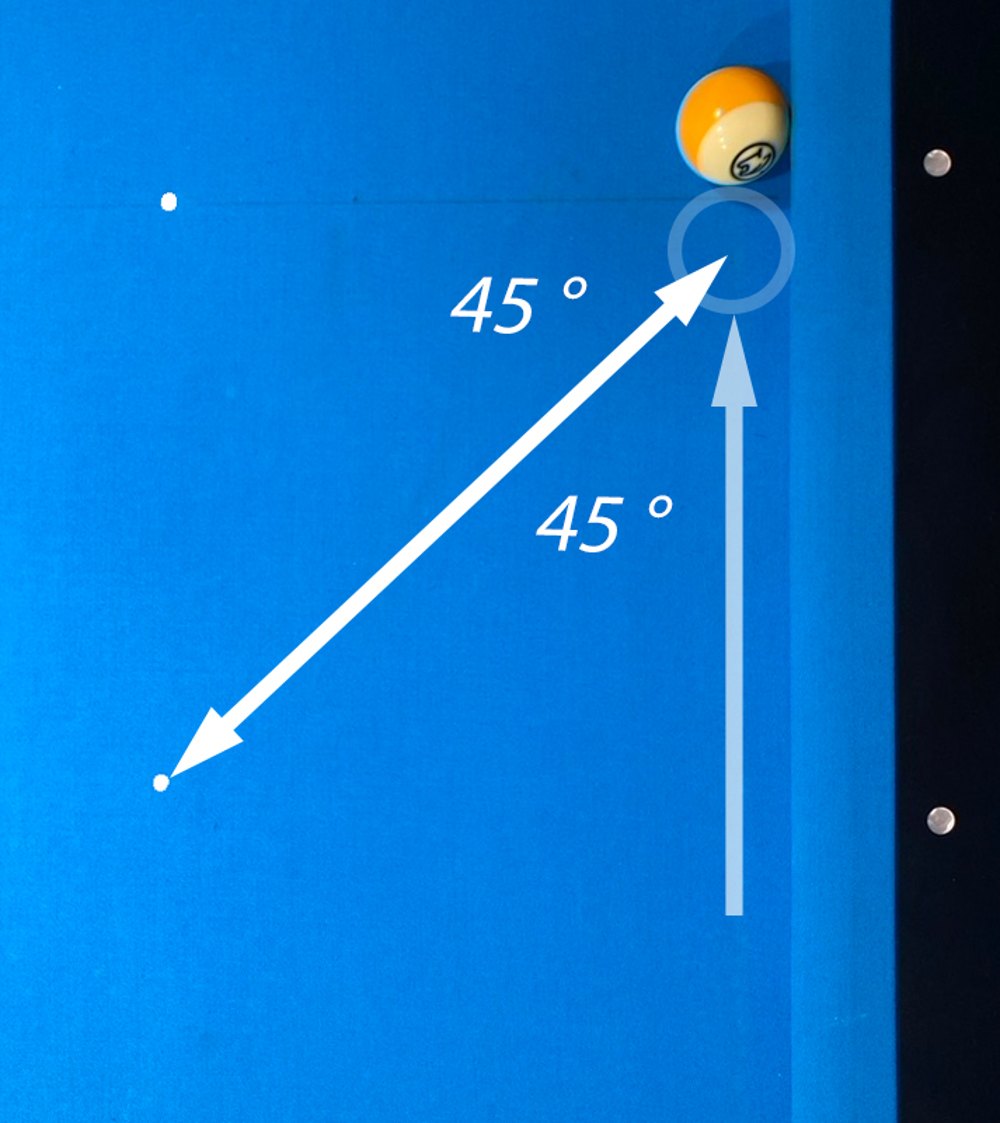
About aim and pot
As a pool player, you invariably ask yourself the same question:
Where exactly do I need to strike the object ball (or the colored ball) to sink it into the pocket?
For a long time now, various methods have existed to simplify the aiming process.
Undoubtedly, the most widely used and simplest method is "Ghost Ball Aiming."
Other techniques—such as aiming via parallel displacement—also exist, though they take some getting used to.
With many of these techniques, you aim at an imaginary ball—
one that represents the cue ball at the precise moment of impact,
and which lies in a straight line with the object ball and the intended path toward the pocket.
In other words: the point of impact is not the point of aim.
The only exceptions are when the balls are aligned perfectly straight toward the pocket, or when the balls follow a curved trajectory.
Naturally, it follows that visualizing this mental image—or the specific spot where you imagine the ghost ball or the point of impact to be—is largely a matter of estimation.
Over time, of course, your accuracy improves and your results become more consistent.
But the inherent imprecision remains.
Or does it?
As pool players, when it comes to simply potting—or sinking—a ball, we are also keenly interested in the *potting angle*!
And this potting angle is defined by two lines:
First, the *line of entry*—that is, the intended trajectory of the object ball.
And second, the *line of aim*—the intended trajectory of the cue ball.
These two lines converge at the center of the ghost ball, thereby forming the potting angle.
As is well known, this angle typically ranges from 0° to—theoretically speaking—90°.
In practice, however, angles of around 80° to 85° represent the upper limit of what is actually achievable.
What if you could estimate this potting angle *before* taking your shot
with such precision that you could visualize the exact position of the ghost ball with pinpoint accuracy?
And what if—after just a little practice—you also gained a precise understanding of cue ball deflection and the effects of side spin on the ball?
Aim and pot.As a pool player, you invariably ask yourself the same question:
Where exactly do I need to strike the object ball (or the colored ball) to sink it into the pocket?
For a long time now, various methods have existed to simplify the aiming process.
Undoubtedly, the most widely used and simplest method is "Ghost Ball Aiming."
Other techniques—such as aiming via parallel displacement—also exist, though they take some getting used to.
With many of these techniques, you aim at an imaginary ball—
one that represents the cue ball at the precise moment of impact,
and which lies in a straight line with the object ball and the intended path toward the pocket.
In other words: the point of impact is not the point of aim.
The only exceptions are when the balls are aligned perfectly straight toward the pocket, or when the balls follow a curved trajectory.
Naturally, it follows that visualizing this mental image—or the specific spot where you imagine the ghost ball or the point of impact to be—is largely a matter of estimation.
Over time, of course, your accuracy improves and your results become more consistent.
But the inherent imprecision remains.
Or does it?
As pool players, when it comes to simply potting—or sinking—a ball, we are also keenly interested in the *potting angle*!
And this potting angle is defined by two lines:
First, the *line of entry*—that is, the intended trajectory of the object ball.
And second, the *line of aim*—the intended trajectory of the cue ball.
These two lines converge at the center of the ghost ball, thereby forming the potting angle.
As is well known, this angle typically ranges from 0° to—theoretically speaking—90°.
In practice, however, angles of around 80° to 85° represent the upper limit of what is actually achievable.
What if you could estimate this potting angle *before* taking your shot
with such precision that you could visualize the exact position of the ghost ball with pinpoint accuracy?
And what if—after just a little practice—you also gained a precise understanding of cue ball deflection and the effects of side spin on the ball?
Aim and pot.
Now, a little about me:
Why am I able to do this—and why do I do it?
Even as a child, driven purely by a playful instinct, I used to draw triangles. I did this because I realized just how much one could achieve with those three simple lines.
The ancient Greeks knew this, too.
As a professional in the field of mechanical engineering, applying trigonometry—the mathematics of triangles—is a daily routine.
And if you want to earn a master's qualification in the field, you have to hit the books; that’s when the challenge becomes: "Find the triangle."
So, it was a natural step to apply this concept to the game of pool.
The result is a method for pinpointing highly accurate aiming points.
The secret lies in recognizing the perpendicular angle.
Once that angle is identified, there are no longer any limits to what you can pocket—from the simplest shots to the absolute toughest ones.
According to current research, there is no method anywhere in the world more precise than mine for calculating the position of the "ghost ball" and determining an aiming line—all without the aid of any external tools right there at the pool table.
How about you? What happens when you miss a shot?
How often do you find yourself shaking your head while standing at the table?
Best regards Jörg.
25%
Kontaktformular
Du kannst das folgende kurze Formular ausfüllen ,wenn Du mich kontaktieren willst:

© 2026 Aimandpot. Alle Rechte vorbehalten
Diese Website ist kein Teil der Facebook-Website oder von Facebook Inc. Darüber hinaus wird diese Website in keiner Weise von Facebook unterstützt. FACEBOOK ist eine Marke von FACEBOOK, Inc.